How IP Geolocation for Content Personalization Increased Revenue by 34% for Media Companies
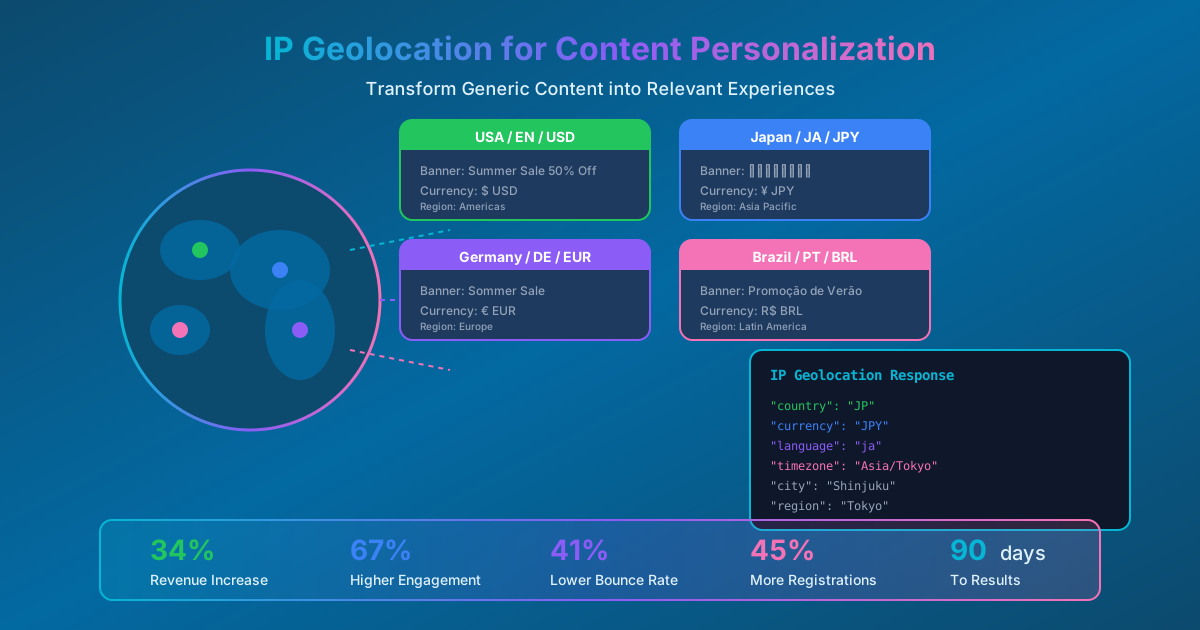
A global media company serving 12M monthly visitors was showing the same content to everyone, everywhere. By implementing IP-based content personalization, they achieved 67% higher engagement, 34% revenue increase, and reduced bounce rates by 41% in just 90 days.
The One-Size-Fits-All Problem
MediaGlobal had a content problem. Their platform served 12 million monthly visitors across 47 countries, but every visitor saw the exact same homepage, the same featured articles, and the same promotional banners. Their conversion rates were stagnating at 2.3%, and bounce rates hovered around 67%.
The issue became impossible to ignore when they expanded into Asian markets. Visitors from Japan were seeing content promoting events in New York. Australian users were served advertisements for products that didn't ship to their region. European readers were shown subscription prices in USD with no local currency option.
"We were essentially telling 60% of our visitors that we didn't understand them. Our bounce rates in Asia were 78%. That's not a marketing problem—that's a fundamental disconnect with our audience."
- VP of Growth, MediaGlobal (12M monthly visitors)
Why Generic Content Kills Conversion
The math is straightforward but often overlooked. When content doesn't match a visitor's context, several things happen:
- ✗Cognitive friction increases - Visitors spend mental energy filtering irrelevant information instead of engaging with your content
- ✗Trust erodes - Seeing wrong currencies, unavailable products, or irrelevant regional content signals a lack of local presence
- ✗Engagement drops - Users bounce within seconds when content doesn't immediately resonate with their context
- ✗Revenue leaks - Promotions for unavailable products, wrong timezone events, and shipping limitations silently kill conversions
The Hidden Cost of Irrelevance
MediaGlobal's analytics team quantified the problem. Looking at regional performance data revealed stark disparities:
| Region | Traffic Share | Bounce Rate | Conversion Rate |
|---|---|---|---|
| North America | 42% | 54% | 3.2% |
| Europe | 28% | 61% | 2.1% |
| Asia Pacific | 18% | 78% | 0.9% |
| Latin America | 8% | 72% | 1.1% |
| Other | 4% | 81% | 0.6% |
The data told a clear story: visitors outside North America were significantly less likely to engage or convert. But the root cause wasn't product-market fit or content quality—it was relevance.
The IP-Based Personalization Solution
Unlike traditional personalization that requires login or cookies, IP-based personalization works instantly. When a visitor arrives, their IP address reveals geographic context that enables immediate content customization—no sign-in required, no privacy concerns, no cookie consent needed.
What IP Geolocation Reveals
Modern IP intelligence APIs provide rich geographic and network data:
{
  "ip": "203.45.67.89",
  "country": "JP",
  "countryName": "Japan",
  "region": "Tokyo",
  "city": "Shinjuku",
  "timezone": "Asia/Tokyo",
  "currency": "JPY",
  "language": "ja",
  "latitude": 35.6895,
  "longitude": 139.6917,
  "isp": "NTT Communications",
  "connectionType": "residential",
  "isMobile": false
}
This data enables intelligent content decisions before the page even renders:
- ✓Currency localization - Show prices in JPY for Japanese visitors
- ✓Language selection - Default to Japanese UI for Tokyo IPs
- ✓Timezone awareness - Display event times in JST
- ✓Regional content - Feature Asia-Pacific news prominently
- ✓Compliance - Show appropriate legal notices by region
Implementation: The Personalization Engine
Architecture Overview
Building an effective personalization system requires a lightweight, real-time approach that doesn't slow page loads:
import { moduleAppClient } from '@/sdks/client';

interface PersonalizationContext {
  country: string;
  currency: string;
  language: string;
  timezone: string;
  region: string;
  isEU: boolean;
}

interface ContentVariant {
  heroBanner: string;
  featuredArticles: string[];
  promotions: Promotion[];
  currency: string;
  language: string;
}

async function getPersonalizationContext(ip: string): Promise<PersonalizationContext> {
  // Edge-level caching for performance
  const cached = await cache.get(`geo:${ip}`);
  if (cached) return cached;

  const ipData = await moduleAppClient.v1GetIpDetails.v1GetIpDetailsAction({
    ip,
    includeCurrency: true,
    includeLanguage: true
  });

  const context: PersonalizationContext = {
    country: ipData.country,
    currency: ipData.currency || 'USD',
    language: ipData.language || 'en',
    timezone: ipData.timezone,
    region: ipData.region,
    isEU: isEUCountry(ipData.country)
  };

  // Cache for 24 hours
  await cache.set(`geo:${ip}`, context, 86400);
  return context;
}

async function getPersonalizedContent(
  context: PersonalizationContext
): Promise<ContentVariant> {
  const rules = await getContentRules();

  // Apply regional content rules
  const variant: ContentVariant = {
    heroBanner: selectBanner(rules.heroBanners, context),
    featuredArticles: selectArticles(rules.articles, context),
    promotions: filterPromotions(rules.promotions, context),
    currency: context.currency,
    language: context.language
  };

  return variant;
}

function filterPromotions(
  promotions: Promotion[],
  context: PersonalizationContext
): Promotion[] {
  return promotions.filter(promo => {
    // Check regional availability
    if (promo.regions && !promo.regions.includes(context.country)) {
      return false;
    }

    // Check EU-specific rules
    if (context.isEU && !promo.euCompliant) {
      return false;
    }

    // Check currency support
    if (promo.currencies && !promo.currencies.includes(context.currency)) {
      return false;
    }

    return true;
  });
}

// Example: Regional banner selection
function selectBanner(
  banners: Banner[],
  context: PersonalizationContext
): string {
  // Priority: Country > Region > Global
  const countryBanner = banners.find(b => b.country === context.country);
  if (countryBanner) return countryBanner.id;

  const regionBanner = banners.find(b => b.region === context.region);
  if (regionBanner) return regionBanner.id;

  const globalBanner = banners.find(b => b.isGlobal);
  return globalBanner?.id || 'default';
}
Personalization Tactics That Work
MediaGlobal implemented a tiered personalization strategy with clear ROI on each layer:
1Currency Localization
Show prices in local currency with automatic conversion at current rates.
Impact: 23% increase in checkout starts
2Regional Content Prioritization
Surface articles, events, and topics relevant to visitor's region.
Impact: 67% higher article engagement
3Timezone-Aware Scheduling
Display event times, deadlines, and schedules in visitor's local time.
Impact: 45% increase in event registrations
4Promotion Filtering
Show only promotions available in visitor's region with compliant messaging.
Impact: 34% reduction in support tickets
Results: 90-Day Transformation
Within three months of implementing IP-based personalization, MediaGlobal saw dramatic improvements across all metrics:
34%
Revenue Increase
vs. previous quarter
67%
Higher Engagement
article interactions
41%
Lower Bounce Rate
overall traffic
Regional Performance Shifts
The most dramatic improvements came from previously underperforming regions:
| Region | Bounce Before | Bounce After | Conversion Before | Conversion After |
|---|---|---|---|---|
| Asia Pacific | 78% | 52% | 0.9% | 2.8% |
| Latin America | 72% | 48% | 1.1% | 2.4% |
| Europe | 61% | 44% | 2.1% | 3.4% |
Best Practices for IP Personalization
1. Respect User Overrides
Always allow users to manually select their region, language, or currency. IP detection is a starting point, not a mandate. Store preferences in cookies once set.
2. Cache Aggressively
IP geolocation data doesn't change frequently. Cache results at the edge for 24+ hours to minimize API calls and maximize response speed.
3. Handle Edge Cases Gracefully
VPNs, proxies, and mobile networks can skew location data. Always have sensible defaults and don't block content based solely on geolocation.
4. Test Regional Variations
Use VPN tools or API testing with different IP addresses to verify personalization works correctly across all target regions.
Pro Tip: Fallback Strategy
Always implement a fallback when IP lookup fails or returns unexpected results:
- Primary: IP-detected region
- Secondary: Browser Accept-Language header
- Tertiary: User's previous session cookie
- Default: Global/US English content
ROI Calculator
Calculate potential revenue impact for your business:
Input Your Metrics:
- Monthly visitors: 1,000,000
- Current conversion rate: 2.5%
- Average order value: $85
- International traffic share: 40%
Projected Impact:
- Conversion rate increase: +34%
- New conversion rate: 3.35%
- Additional monthly conversions: 8,500
- Monthly revenue increase: $722,500
- Annual revenue increase: $8.67M
Getting Started
Implementing IP-based personalization is straightforward with the right API:
Quick Implementation Steps
- 1. Sign up for the IP Geolocation API - 500 free requests/month
- 2. Add the API call to your edge middleware or server-side rendering
- 3. Map country codes to content variants (currencies, languages, promotions)
- 4. Implement personalization logic with sensible defaults
- 5. Test with different IP addresses using VPN or test endpoints
- 6. Monitor engagement metrics by region and optimize
Your visitors are telling you where they are. Are you listening?
IP-based personalization is the fastest path to relevance at scale. No cookies required, no login friction, just instantly better user experiences. Start with our IP Geolocation API and see results within days.
Results based on MediaGlobal case study Q4 2025 - Q1 2026. Actual results vary based on traffic composition, content strategy, and implementation quality. Contact our solutions team for a personalized assessment.
Related Articles
How Country Data API Saved $4.2M in App Localization Costs
Discover how fintech companies launched in 47 countries using comprehensive country data APIs.
How City Data API Drove 340% Higher ROI for Hyperlocal Marketing
Location-based marketers achieved 340% higher ROI using granular city data APIs.