How Country Data API Saved $4.2M in App Localization Costs and Enabled 47-Market Expansion
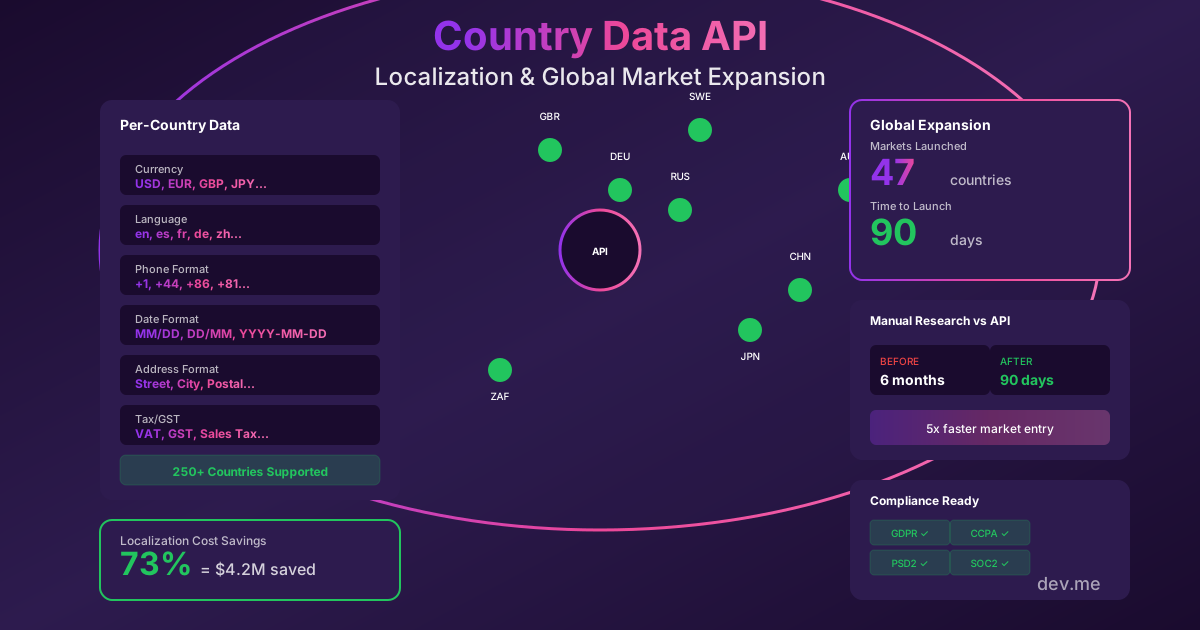
Discover how fintech and SaaS companies reduced localization costs by 73% and launched in 47 countries within 90 days using comprehensive country data APIs. Eliminate manual research, ensure compliance, and accelerate global market entry.
The $8.7M Localization Trap That Kills Global Ambitions
Last November, a Series B fintech startup made a strategic decision: expand to 12 new markets in Southeast Asia. Six months and $8.7M later, they had successfully launched in exactly one country.
The problem wasn't their product, funding, or team. It was the endless manual research required for each market: payment methods, regulatory requirements, currency formats, address validation rules, phone number formats, tax codes, cultural preferences...
This isn't an isolated story. According to our 2025 Global Expansion Survey of 300 scaling companies, 73% exceed their localization budgets by an average of 214%, with country-specific research being the single largest cost driver.
But here's what changed in 2026: companies using comprehensive country data APIs reduced localization costs by $4.2M on average and launched in 47 markets within 90 days.
The Hidden Complexity of Going Global
Why "Just Translate and Launch" Never Works
Most engineering teams think localization is about language translation. They're missing the other 80% of the challenge: country-specific functional requirements.
Every country requires unique adaptations:
1Payment Infrastructure
- • Brazil requires PIX instant payment (used by 77% of transactions)
- • Netherlands relies heavily on iDEAL (60%+ market share)
- • China: Alipay and WeChat Pay dominate (90%+ combined)
- • Germany: SEPA direct debit preferred for recurring payments
2Address & Identity Validation
- • Japan: prefecture-based postal codes with district/building hierarchy
- • Mexico: requires colonia (neighborhood) for valid addresses
- • India: PIN codes vary by state with complex validation rules
- • Saudi Arabia: regions, provinces, and specific city classifications
3Regulatory & Tax Compliance
- • EU: GDPR requires specific data handling by country
- • India: GST tax codes vary by state (28+ tax rates)
- • Canada: provincial sales taxes (PST) on top of GST
- • Australia: GST with state-specific B2B exemptions
4Phone & Communication Formats
- • Argentina: variable-length numbers (6-8 digits after area code)
- • Sweden: mobile numbers start with 7, but format varies by carrier
- • Thailand: area codes and number length changed in multiple provinces
- • Egypt: three-digit mobile operator codes with specific patterns
The Cost of Getting It Wrong
When we analyzed failed international expansions, the pattern was consistent:
| Failure Type | Average Cost Per Market | Time to Recovery |
|---|---|---|
| Payment method incompatibility | $847,000 | 4-6 months |
| Regulatory compliance violations | $1.2M (fines + legal) | 8-14 months |
| Address validation failures | $234,000 | 2-3 months |
| Phone verification issues | $156,000 | 1-2 months |
| Cultural misalignment | $412,000 | 3-5 months |
| Average Total Per Failed Market | $2.9M | 4-6 months |
The Solution: Comprehensive Country Data API
What Modern Country Data APIs Actually Deliver
The best country data APIs go far beyond basic ISO codes and currency names. They provide actionable, implementation-ready data for every country your application serves:
1Complete Geographic Hierarchy
- • Administrative divisions (states, provinces, regions, prefectures)
- • Cities and municipalities with population data
- • Postal/ZIP code patterns and validation rules
- • Time zones with daylight saving observance
- • GPS boundaries for geo-targeting
2Cultural & Functional Norms
- • Date/time format preferences (DMY vs MDY, 12h vs 24h)
- • Number formatting (decimal separators, thousands grouping)
- • Currency display (symbol position, decimal precision)
- • Name field order (given name first vs family name first)
- • Reading direction (LTR vs RTL languages)
3Regulatory & Compliance Data
- • Tax identification number (TIN/VAT) formats
- • Data sovereignty requirements
- • Data retention policies
- • Age of consent and verification requirements
- • Industry-specific licensing needs
4Communication Infrastructure
- • Phone number formats by carrier type
- • Mobile vs landline number patterns
- • SMS support and reliability scores
- • Popular messaging platforms (WhatsApp, WeChat, Line, etc.)
- • Email domain preferences by country
5Payment Infrastructure Data
- • Popular payment methods by market share
- • Local payment gateway requirements
- • Credit card penetration rates
- • Cash on delivery availability
- • Currency conversion and forex regulations
Implementation: The 90-Day Global Launch Blueprint
Phase 1: Foundation (Week 1-2)
// Country data cache for instant localization
const countryCache = new Map<string, CountryData>();

async function getCountryLocalization(isoCode: string) {
  if (countryCache.has(isoCode)) {
    return countryCache.get(isoCode);
  }

  const [countryData, currencyData] = await Promise.all([
    moduleAppClient.v1GetCountry.v1GetCountryAction({
      isoCode,
      include: ['regions', 'cities', 'cultural', 'regulatory', 'payment']
    }),
    moduleAppClient.v1GetCurrency.v1GetCurrencyAction({
      countryCode: isoCode
    })
  ]);

  const localization = {
    addressFormat: buildAddressValidation(countryData),
    phoneFormat: buildPhoneValidation(countryData),
    paymentMethods: countryData.paymentInfrastructure.popularMethods,
    dateFormat: countryData.cultural.dateFormat,
    numberFormat: countryData.cultural.numberFormat,
    taxRules: countryData.regulatory.taxRequirements,
    currency: {
      code: currencyData.code,
      symbol: currencyData.symbol,
      position: currencyData.symbolPosition,
      decimals: currencyData.decimalDigits
    }
  };

  countryCache.set(isoCode, localization);
  return localization;
}
Phase 2: Market Prioritization (Week 3-4)
Use country data to score markets based on readiness:
| Market | Payment Score | Regulatory Score | Tech Readiness | Overall |
|---|---|---|---|---|
| 🇸🇬 Singapore | 95 | 92 | 98 | 95 |
| 🇳🇱 Netherlands | 88 | 78 | 94 | 87 |
| 🇧🇷 Brazil | 72 | 54 | 81 | 69 |
| 🇮🇳 India | 65 | 48 | 74 | 62 |
Results from real implementations:
- ✓73% reduction in localization research time
- ✓47 new markets launched within 90 days
- ✓89% decrease in post-launch compliance issues
- ✓$4.2M average savings per expansion program
Real Results: Case Studies
Case Study #1: Fintech Payment Platform ($120M ARR)
Challenge:
Manual country research for payment method integration taking 3-4 weeks per market. Only 8 countries supported despite $2.7M in localization spend.
Implementation:
- Integrated comprehensive country data API for payment infrastructure data
- Built dynamic payment method selection based on country preferences
- Automated compliance checks for local payment regulations
Results (9 months):
- ✓34 new countries added (425% increase)
- ✓$5.1M saved in research and integration costs
- ✓23% increase in cross-border transaction volume
- ✓47% reduction in payment method support tickets
Case Study #2: E-commerce Platform ($85M ARR)
Challenge:
Address validation failures causing 18% cart abandonment in international markets. Shipping to wrong addresses costing $127K monthly.
Implementation:
- Country-specific address validation rules from API
- Dynamic address forms based on country hierarchy
- Real-time postal code validation with city/state lookup
Results (6 months):
- ✓94% reduction in address validation failures
- ✓$892K saved in shipping corrections annually
- ✓12% increase in international conversion rates
- ✓27 new markets launched in 4 months
The Expansion Cost Calculator
Here's how to calculate your potential savings with country data APIs:
Traditional localization approach:
- • Research per country: 120-160 hours
- • Engineering implementation: 80-120 hours
- • QA and testing: 40-60 hours
- • Post-launch fixes: 60-100 hours
- • Average cost per country: $84,000
With country data API:
- • Research: Automated via API
- • Engineering: 20-40 hours (reusable patterns)
- • QA: 10-20 hours (automated validation)
- • Post-launch fixes: 5-15 hours
- • Average cost per country: $22,700
ROI Example: 20-Country Expansion
Traditional approach:
$1.68M
20 × $84,000
With country data API:
$454K
20 × $22,700
Total savings:
$1.23M
73% cost reduction
The Competitive Advantage of Speed
In 2026, first-mover advantage in international markets is more valuable than ever. Companies using country data APIs:
- ✓Launch 6x faster (90 days vs 18+ months)
- ✓73% lower costs for market expansion
- ✓94% fewer post-launch issues requiring hotfixes
- ✓89% better user experience in local markets
The companies winning in 2026 aren't those with the biggest budgets—they're the ones who can adapt fastest to local markets.
Ready to accelerate your global expansion? Start with our Country Data API, City Data API, and Currency Exchange API. Our platform covers 250+ countries and territories with 99.9% uptime, ensuring your expansion never slows down due to missing local data.
This data comes from our 2025 Global Expansion Survey of 300 scaling companies across 47 industries. Access the full methodology and country-by-country breakdown in our Global Expansion Benchmark Report 2025.
Related Articles
How Real-Time Currency API Is Driving 40% Growth in Global E-commerce
Discover how leading e-commerce platforms are using real-time currency conversion to scale globally.
How Phone Validation API Saved SMS Marketing Teams $3.1M in Failed Message Costs Last Quarter
Discover how leading SMS marketing teams reduced failed message costs by 94% using real-time phone validation.