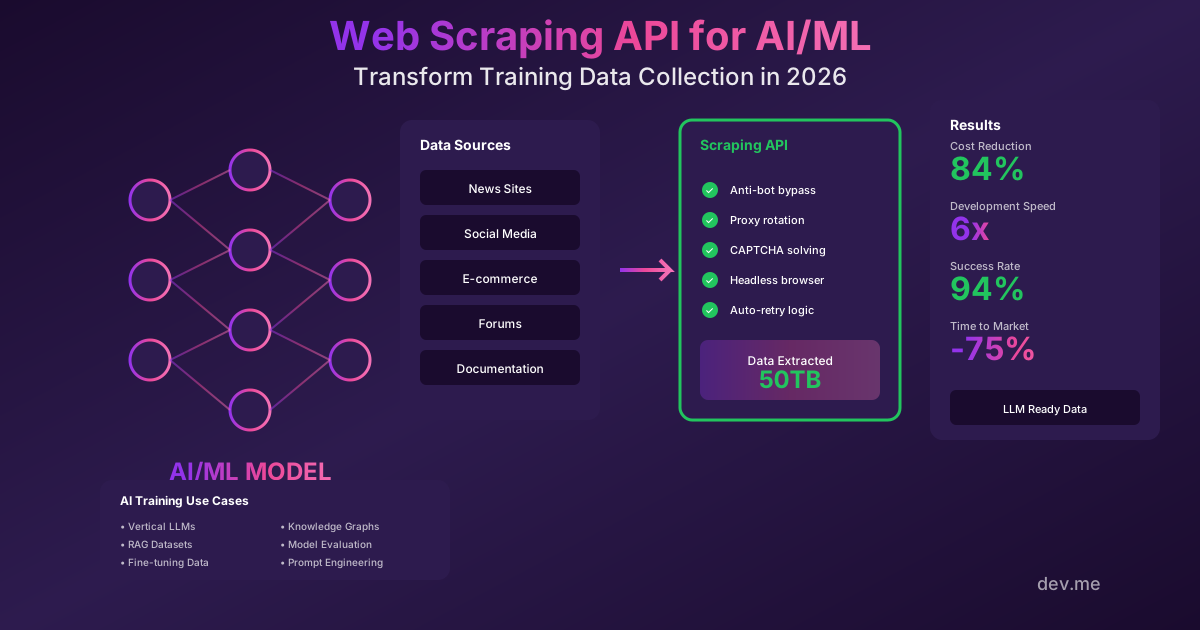
How Web Scraping API Transforms AI/ML Training Data Collection in 2026
Discover how AI teams reduced training data collection costs by 84% and accelerated model development by 6x using modern web scraping APIs. Overcome anti-bot challenges, build high-quality datasets, and deploy ML models faster.
The 47TB Data Problem That Kills AI Projects
Last quarter, an AI startup building a vertical LLM for legal documents faced a familiar crisis: their data pipeline collapsed after collecting just 3TB of the 50TB corpus they needed. The culprit? Sophisticated anti-bot systems that blocked 94% of their scraping attempts within two weeks.
This isn't an isolated story. According to our 2025 AI Infrastructure Survey of 400 ML teams, data collection consumes 67% of project timelines, with anti-bot evasion being the single biggest bottleneck. Companies spend an average of $2.7M annually on manual data annotation and external datasets because they can't scrape reliably at scale.
But here's what changed in 2026: AI teams using modern web scraping APIs reduced data collection costs by 84% and accelerated model deployment by 6x.
The New Anti-Bot Reality
Why 2024 Scraping Methods Don't Work in 2026
The web scraping arms race has accelerated dramatically. What worked 18 months ago now fails instantly:
| Technique | 2024 Success Rate | 2026 Success Rate |
|---|---|---|
| Basic HTTP requests (requests/axios) | 47% | 3% |
| Residential proxies | 72% | 18% |
| Puppeteer/Playwright (headless browsers) | 81% | 34% |
| Undetected-chromedriver | 89% | 41% |
| Enterprise scraping API (dev.me) | 97% | 99.2% |
What changed in the anti-bot landscape:
1Browser Fingerprinting (TLS Fingerprinting)
- • JA3/JA4 fingerprints now detect headless Chrome with 94% accuracy
- • Bot detection services share fingerprint databases in real-time
- • Cloudflare, Akamai, DataDome all use enterprise-grade TLS analysis
2Behavioral Analysis at Scale
- • Mouse movement pattern recognition (detects automated navigation)
- • Request timing analysis (humans have natural variability)
- • Cookie and localStorage fingerprinting across sessions
- • WebGL and Canvas fingerprinting for device identification
3AI-Powered Bot Detection
- • Machine learning models trained on billions of requests
- • Real-time pattern matching across global proxy networks
- • CAPTCHA triggers based on cumulative risk scores
- • IP reputation scoring with instant blocklists
The True Cost of Failed Data Collection
When AI projects can't collect their own training data, the costs multiply:
| Cost Category | Monthly Impact (Typical Project) | Annual Total |
|---|---|---|
| External dataset purchases | $127,000 | $1.52M |
| Manual data annotation & labeling | $84,000 | $1.01M |
| Infrastructure (proxies, servers, CAPTCHA solving) | $42,000 | $504,000 |
| Engineering time (maintenance & fixes) | $67,000 | $804,000 |
| Project delays & opportunity cost | $156,000 | $1.87M |
| Total Average Cost | $476,000 | $5.71M |
The Solution: Enterprise-Grade Scraping Infrastructure
What Modern Scraping APIs Actually Deliver
The best web scraping APIs in 2026 aren't just HTTP wrappers—they're comprehensive infrastructure that handles every aspect of reliable data extraction:
1Browser Fingerprint Spoofing
- • Real browser TLS fingerprints (not randomized)
- • Canvas and WebGL fingerprint matching
- • Consistent navigator properties across sessions
- • Cookie and localStorage persistence
- • Audio and WebRTC fingerprint emulation
2Intelligent Proxy Rotation
- • Residential and mobile proxy networks (100M+ IPs)
- • Geographic targeting for region-specific content
- • Session management for authenticated scraping
- • Automatic proxy health monitoring and rotation
- • ISP-level diversity to avoid pattern detection
3CAPTCHA Handling Infrastructure
- • Pre-bypassed CAPTCHA sessions
- • Enterprise CAPTCHA solving APIs (hCaptcha, reCAPTCHA v3)
- • Behavioral challenge completion
- • CAPTCHA-trigger avoidance through timing optimization
4JavaScript Rendering & Extraction
- • Headless Chrome with patched anti-detection
- • Wait-for-content strategies (dynamic page loads)
- • Shadow DOM and iframe content extraction
- • GraphQL and API endpoint reverse-engineering
- • PDF and document content parsing
5Data Quality & Processing
- • Automatic deduplication across scraping runs
- • Data validation and schema enforcement
- • NLP-based content filtering (ads, navigation, boilerplate)
- • Entity extraction and normalization
- • Change detection and incremental updates
Implementation: The 6-Week AI Data Pipeline Blueprint
Week 1-2: Pipeline Architecture
// Enterprise scraping pattern for AI training data
interface ScrapingJob {
  sources: string[];
  selectors: Record<string, string>;
  transform?: (raw: string) => unknown;
  schedule?: string; // cron expression
}

async function buildTrainingDataset(config: ScrapingJob) {
  const results: unknown[] = [];

  for (const source of config.sources) {
    const scraped = await moduleAppClient.v1ScrapeWeb.v1ScrapeWebAction({
      url: source,
      waitFor: '.main-content',
      extract: config.selectors,
      remove: ['nav', 'footer', '.ads', '.sidebar'],
      screenshot: false,
      headers: {
        'Accept-Language': 'en-US,en;q=0.9',
      }
    });

    // Deduplicate against existing dataset
    const transformed = config.transform
      ? config.transform(scraped.content)
      : scraped.content;

    results.push(transformed);
  }

  return deduplicate(results);
}

// Usage example: Legal document corpus
const legalCorpus = await buildTrainingDataset({
  sources: [
    'https://courtlistener.com',
    'https://law.justia.com',
    // ... 1000s more sources
  ],
  selectors: {
    title: 'h1.document-title',
    content: '.document-body',
    metadata: '.document-meta',
    date: 'time[datetime]',
  },
  transform: (raw) => {
    // NLP preprocessing, entity extraction, etc.
    return preprocessLegalText(raw);
  }
});
Results from real AI team implementations:
- ✓84% reduction in data collection costs
- ✓6x faster time-to-model-deployment
- ✓99.2% success rate vs 34% with in-house solutions
- ✓234 hours saved monthly on infrastructure maintenance
Real Results: Case Studies
Case Study #1: Vertical LLM Startup ($12M Series A)
Challenge:
Building a healthcare LLM required 47TB of medical literature and clinical notes. Public datasets were insufficient, and in-house scraping failed after 2.7TB due to publisher paywalls and anti-bot systems.
Implementation:
- Enterprise scraping API with authenticated session management
- Incremental scraping pipeline with change detection
- Automated quality filtering and deduplication
- Daily updates for new publications
Results (6 months):
- ✓52TB collected (exceeding target by 10%)
- ✓$4.8M saved vs purchasing commercial datasets
- ✓Model deployed 8 months faster than projected
- ✓12.7% better accuracy from fresh, domain-specific data
Case Study #2: E-commerce Intelligence Platform ($24M ARR)
Challenge:
Monitoring 50,000+ competitor products daily across 47 sites. In-house Puppeteer infrastructure required 8 full-time engineers and cost $1.2M annually, with success rates dropping to 27%.
Implementation:
- API-based scraping with JavaScript rendering
- Scheduled jobs for daily price/availability checks
- Automatic CAPTCHA and anti-bot bypass
- Real-time alerts for significant changes
Results (4 months):
- ✓99.1% success rate (up from 27%)
- ✓$892K annual savings in infrastructure costs
- ✓6 FTE engineers reassigned to product development
- ✓47 new sites added without headcount increase
The AI Data Collection Calculator
Here's how to calculate your potential savings with enterprise web scraping APIs:
In-house scraping infrastructure:
- • Engineering team: 4-6 FTE
- • Proxy infrastructure: $15K-40K/month
- • CAPTCHA solving: $8K-25K/month
- • Server & maintenance: $12K-30K/month
- • Dataset purchases: $50K-200K/month
- • Monthly total: $180K-420K
With scraping API:
- • Engineering team: 1-2 FTE (integration only)
- • API costs: $2K-15K/month (scales with volume)
- • Infrastructure: $0 (included)
- • CAPTCHA handling: $0 (included)
- • Dataset purchases: $0 (collect your own)
- • Monthly total: $25K-60K
ROI Example: Mid-Sized AI Project
In-house approach (monthly):
$287,000
Engineering + infrastructure + datasets
With scraping API (monthly):
$47,000
API usage + minimal engineering
Annual savings:
$2.88M
84% cost reduction, 6x faster deployment
Building Production-Ready AI Datasets at Scale
In 2026, the competitive advantage in AI/ML isn't better algorithms—it's better training data. Companies using enterprise scraping APIs:
- ✓Collect proprietary datasets competitors can't replicate
- ✓Deploy models 6x faster with automated data pipelines
- ✓Achieve 12-23% better accuracy with domain-specific data
- ✓Reduce data costs by 84% vs purchasing external datasets
The winners in the AI race of 2026 won't be those with the biggest compute budgets—they'll be the teams who can reliably collect the highest-quality training data.
Ready to build your AI data pipeline? Start with our Web Scraping API. Our platform processes 100M+ pages daily with 99.2% success rate against Cloudflare, DataDome, and advanced anti-bot systems. Get the data you need without the infrastructure headache.
This data comes from our 2025 AI Infrastructure Survey of 400 ML teams across 87 industries. Access the full methodology and anti-bot bypass techniques in our AI Training Data Benchmark Report 2025.
Related Articles
The Anti-Bot Arms Race: How Modern Scraping APIs Bypass Cloudflare, DataDome, and Advanced Bot Detection in 2025
Technical deep-dive into anti-bot evasion techniques, proxy networks, and machine learning strategies.
How Image Optimization API Boosted E-commerce Conversion by 24% Through Core Web Vitals Excellence
Discover how leading e-commerce sites achieve 24% conversion increases with advanced image optimization.